
Why natural progress looks slower than your feed
A lot of what you see online is filtered, flexed, dehydrated for the photo — or not natural. Comparing yourself to it is how people conclude their training isn’t working when it is. Everything I coach, and everything on this site, is 100% natural. That changes what “realistic” means.
What realistic looks like
How much muscle you can build depends on training experience, age, genetics, sleep and food. The honest pattern:
- Beginners gain fastest — the first year of proper training is usually the most productive.
- Progress slows the longer you’ve trained. That’s normal, not a sign you’re doing it wrong.
- Scale weight is not muscle. A gain on the scale includes water, stored carbohydrate and some fat alongside muscle.
My own ten months
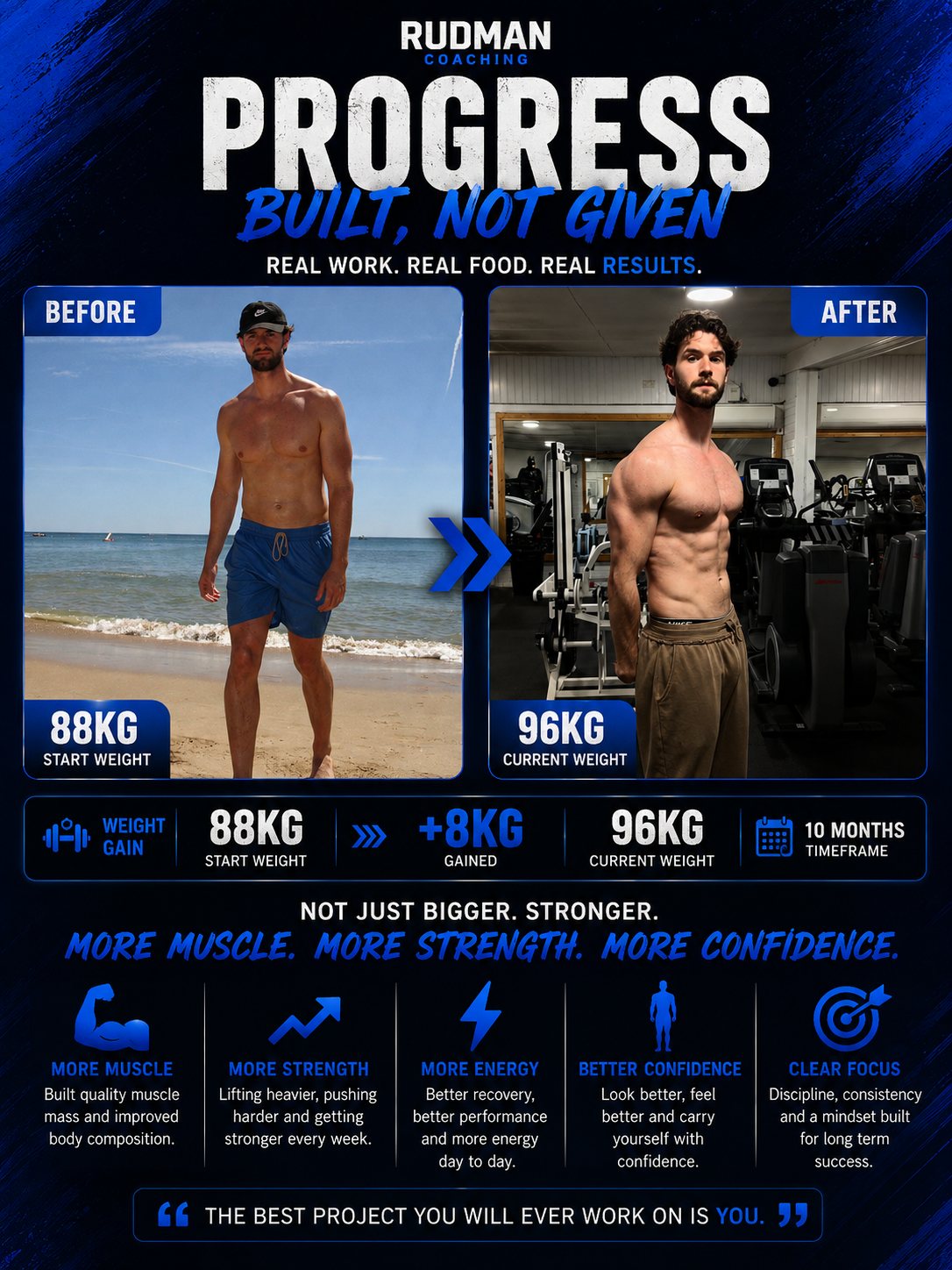
I coached myself with the same Assess, Build, Perform method my clients follow. Over ten months I went from 88kg to 96kg. That’s 8kg of bodyweight — and I’d be misleading you if I called it 8kg of muscle. What I can say is that I got visibly more muscular, stronger across the board, and leaner-looking at a heavier weight. See the before and after.
What actually drives it
Progressive overload
Muscle grows when it’s asked to do a little more over time — more weight, more reps, better control. Track your lifts. If the numbers haven’t moved in a month, the plan needs to change.
A small, steady surplus
Eat slightly more than you burn — enough for bodyweight to creep up gradually. A big surplus mostly adds fat faster, not muscle.
Enough protein
Around 1.6g per kg of bodyweight per day is where research finds the benefit for muscle gain levels off for most people who train.
Sleep and patience
Recovery is where adaptation happens. Judge progress over months, not weeks.
A simple week for building muscle
You don’t need to live in the gym. For most people, three or four sessions a week is plenty, set up so each muscle group is trained around twice a week — for example an upper-body and lower-body split done twice. Most working sets should finish close to the point where you couldn’t do another good rep. Consistency over months beats any clever split.
Why natural progress stalls
- Not tracking. If you don’t know what you lifted last week, you can’t reliably beat it.
- Programme hopping. A new plan every three weeks never lets progress build.
- Not eating enough. Especially common in people who used to diet.
- Short sleep. Recovery is where the work turns into muscle.
- Easy sets. Plenty of volume, but nothing close to challenging.
What about supplements?
None are required. Creatine monohydrate is one of the most researched supplements for strength and muscle, and protein powder is simply a convenient way to hit your protein. If you’re drug-tested or want certainty about what’s in a product, choose batch-tested supplements, and check with your GP first if you have a health condition. Everything else is a distant second to food, training and sleep.
How to measure it honestly
Use more than the scale: strength on your main lifts, a monthly photo in the same light, and a tape measure at the waist. If lifts and photos improve while your waist stays roughly steady, you’re building muscle.
If you want a plan built around what’s realistic for you, book a free consultation. Real work, real food, real results.